
Cobber Casino KYC: Verification Documents and Withdrawal Checks
 Available in AU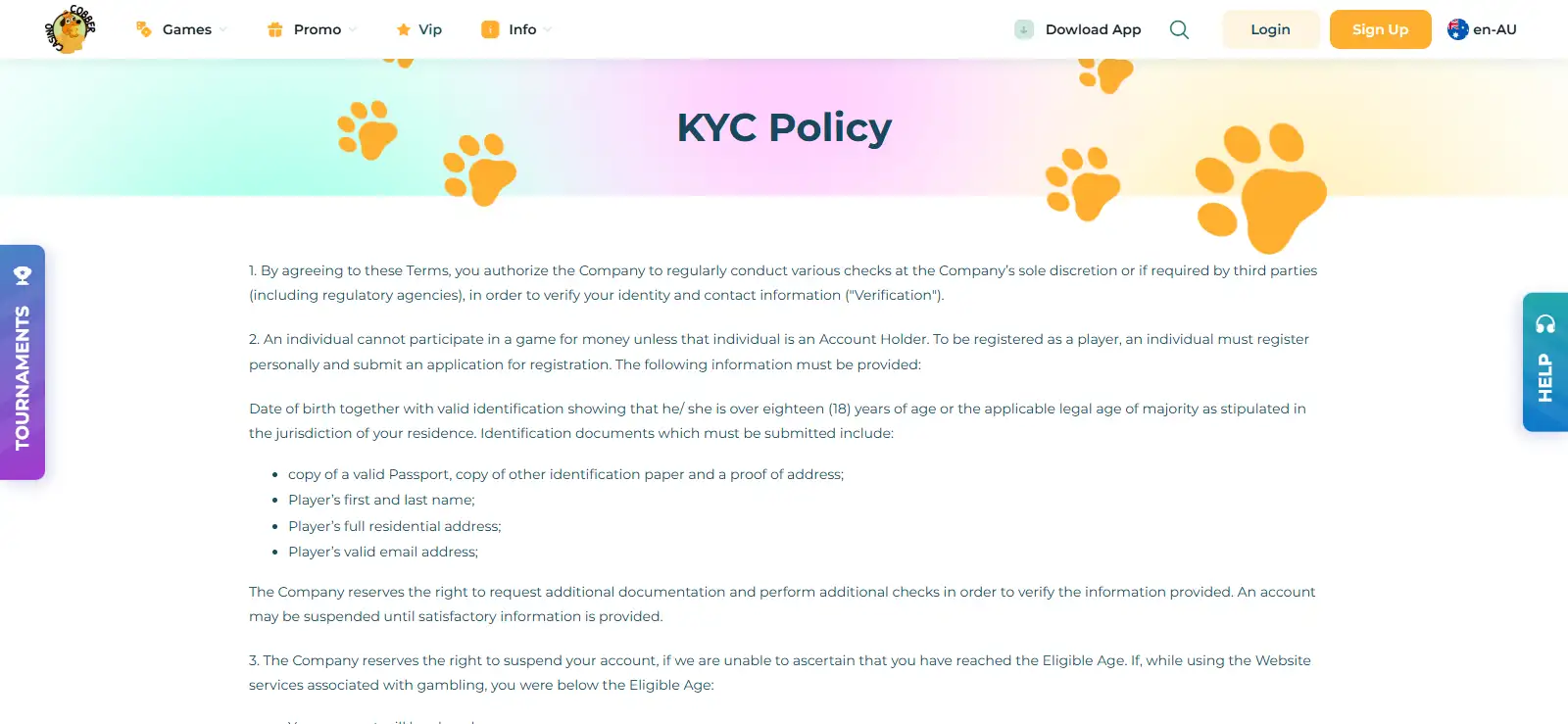
Contents
Cobber can require identity verification before it processes a withdrawal. Its current terms list a valid government-issued photo ID, proof of address and, when requested, proof of the payment method among the documents used for verification. The terms also allow additional documents and phone verification, while a video check can be required in a specific document-script situation. Withdrawals can remain pending until the required verification steps are completed.
Cobber’s About page says supporting-document checks usually take about 10 minutes. That is the operator’s stated typical document-check time, not a guaranteed completion time for every account or withdrawal. A KYC review can take longer when information does not match, extra evidence is requested or the operator needs another verification step.
What documents can Cobber request?
The current Cobber terms and KYC policy support a short core list rather than an open-ended invented checklist. For identity, the terms name a government-issued photo ID such as a passport or driver’s licence. For address, they name documents such as a utility bill or bank statement. They also allow Cobber to request evidence of the payment method used on the account.
| Verification item | Current source position | Practical purpose |
|---|---|---|
| Government-issued photo ID | Explicitly listed in the current terms | Matches the account holder to a recognised identity document |
| Proof of current address | Explicitly listed, with utility bill or bank statement as examples | Checks the residential details connected with the account |
| Proof of payment method | Can be requested when needed | Helps verify that the funding or payout method belongs to the account holder |
| Additional information or documents | Reserved by the operator when further checks are needed | Addresses mismatches, risk checks or incomplete verification |
This distinction matters because a review page can easily overstate KYC by presenting every possible document as mandatory for every player. Cobber’s current wording does not support that. The safer reading is that identity and address evidence form the core verification set, with payment-method evidence and other documents requested when the circumstances require them.
When verification can affect a withdrawal
Cobber’s terms explicitly reserve the right to verify identity before processing withdrawals. They also say withdrawal requests remain pending until required KYC steps are completed. That makes verification status part of payout timing even when the payment method itself would otherwise be fast.
The practical sequence is therefore different from a simple payment-processing timeline. A withdrawal can first encounter an account verification stage, then move to approval and payment processing. The separate Cobber withdrawals guide covers the current payout limits and processing rules; this page focuses on the identity checks that can interrupt or delay that process.
If a player submits false or incomplete KYC documents, the current terms give Cobber broad powers, including refusing a payout and terminating the account. That is a reason to treat the verification request as a compliance step rather than as an obstacle to work around.
Phone and video checks are conditional, not universal
The current terms allow Cobber to request a phone call as part of KYC, and another section says live phone verification may be required in addition to document checks. The terms also describe a video verification route where requested documents cannot be provided in the specified Latin or Cyrillic scripts. That video check involves the player holding an ID and stating identifying information.
These are conditional tools. It would be inaccurate to say every Cobber player must complete a phone or video call. The public sources support the narrower statement that the operator can add these steps in specified circumstances.
The same principle applies to extra documents. If an account presents a mismatch between registration data, identity evidence and payment information, the operator can ask for more evidence. A player should answer the request actually received rather than upload unrelated documents in the hope of speeding up review.
How long does Cobber say document checking takes?
Cobber’s current About page states that checking supporting documents to verify a new player’s identity usually takes about 10 minutes. That wording is useful because it gives an operator-stated expectation, but it does not create a service guarantee. It describes a typical document check, not a maximum deadline for every KYC case or a promise that a withdrawal will arrive within 10 minutes.
A withdrawal can involve other stages after documents are reviewed. Cobber can require additional verification, the payment request can still need approval, and the selected payout method can have its own processing time. For that reason, the 10-minute statement should never be added to a withdrawal estimate as though the full payout process is guaranteed to finish that quickly.
If your review is taking longer, the useful question is not whether the marketing statement has been “broken” but whether the operator has asked for another item, whether account details match the evidence supplied and whether the withdrawal remains in a verification state.
Prepare documents without inventing upload rules
Cobber’s current public policy identifies document categories, but it does not publish one universal file-size limit, image resolution, upload format or freshness period for every type of proof. Those details can vary by verification request and should be taken from the live instructions shown in the account.
There are still sensible quality checks a player can make without inventing policy. Use current documents, make sure names and addresses are readable, and check that the personal details correspond with the account information. Do not crop away information the verification request requires. If an image of a payment method is requested, follow the live instructions on what must be visible and what sensitive details should be obscured.
For a new account, this starts earlier than KYC. The Cobber registration guide explains why accurate registration details matter and why opening a second account is not an appropriate fix for an access or verification problem.
Why data consistency matters
Cobber’s KYC policy says the operator can suspend an account while it is unable to verify the information provided. The terms also treat false, incomplete, inaccurate or misleading registration information seriously. Those rules make consistency across the account, identity document, address evidence and payment ownership a practical issue.
A simple typo does not automatically explain every KYC delay, but mismatched information can create an additional check that would not exist if the records lined up. Before depositing or withdrawing, it is worth reviewing the personal details available in the account and correcting legitimate errors through the operator’s support process where that is possible.
Do not create replacement records or alter documents to force a match. Cobber’s one-person-one-account rule means opening another account can create a second problem, while manipulated verification evidence can trigger much more serious account action.
KYC and the one-account rule
Identity verification does not sit in isolation from Cobber’s account rules. The terms limit each individual to one personal account and contain strict consequences for duplicate accounts. KYC can therefore expose a duplicate-account issue at exactly the point when a player is trying to withdraw.
If you cannot access an old account, use recovery or support rather than registering again. If two people in the same household use the service, the terms also deserve review because shared addresses, IP addresses and devices are mentioned in the duplicate-account rules. The point is not to assume a violation from a shared household, but to avoid creating avoidable ambiguity around identity and account ownership.
Verification does not prove Australian licensing
Completing KYC shows that an operator has performed the checks it requires for the account. It does not establish that the operator holds an Australian local casino licence or that Australian wagering safeguards apply to the account. Licensing and identity verification are separate questions.
Cobber’s operator and offshore licensing evidence, the ACMA register check and the provider-side Australian legal context are covered on the Cobber licence page. Keeping those topics separate prevents a common mistake: treating a familiar compliance process such as KYC as evidence of local regulatory status.
If verification becomes a dispute
Keep a clear record of what Cobber requested, when you supplied it and any response received. Save relevant account messages and note whether the withdrawal is still pending, cancelled or returned for another action. A precise timeline is more useful than repeatedly submitting different copies without knowing what the operator says is missing.
Cobber’s terms include a complaint-handling route starting with support and escalation inside the casino. The Cobber complaints page explains the documented complaint and escalation process, including the limits of what an offshore dispute route means for an Australian reader.
If the issue is simply a missing document, follow the live verification request. If the issue is a disagreement about account action or funds after the requested information has been supplied, a documented complaint is the more structured next step.
KYC checklist before requesting a payout
- Make sure the personal details on the account are accurate and correspond with your identity documents.
- Have a current government-issued photo ID available.
- Have current proof of address available if requested.
- Be ready to verify the payment method if Cobber asks for it.
- Read the exact live request before sending extra documents that were not requested.
- Respond to any phone or video step only through the operator’s documented process.
- Do not assume the operator’s stated typical 10-minute document check is a guaranteed deadline.
- If a withdrawal remains pending, check whether KYC is still incomplete before treating the delay as payment processing.
- Keep copies or records of the request and your response for any later complaint.
For the broader operator overview, return to the Cobber Casino Australia review. KYC is only one part of the decision: account rules, withdrawal limits, licensing context and dispute routes all need to be considered separately.
Current source check
The KYC evidence on this page was rechecked on 17 September 2026 against Cobber’s current Terms and Conditions, KYC/AML policy and About page. The terms still list photo ID, proof of address and payment-method evidence, allow additional document and phone checks, describe conditional video verification, and say withdrawals can remain pending until required verification is complete. The About page still describes supporting-document checks as usually taking about 10 minutes.
Official sources: Cobber Terms and Conditions, Cobber KYC Policy and Cobber About page.
This material was created by the Cobber Casino Australia Guide team.
Related posts

Cobber Casino Games Australia: Library, Providers and Restrictions

Cobber Casino Bonus Australia: Welcome Offer and Key Terms